
Practical sales training courses for beginners that help you improve sales conversations, handle objections, communicate value clearly and close more deals without pushy selling techniques.
Beginner sales training courses for UK business owners, new salespeople, sales teams,
consultants, service providers and advisers who want practical sales skills that work in real conversations.
63 Google Reviews • 102 Client Reviews • 27+ Years in Professional Sales • Helped Businesses Grow by £40m+
Many people choose sales training courses for beginners because they want better sales conversations, stronger sales skills and improved conversion rates without pressure tactics or generic scripts.
Prospects say they'll think about it after sales calls, then disappear before making a decision.
Clients choose the cheapest option because the value is not clear enough during the sales conversation.
You know your service is worth more, but still find yourself reducing the price to get agreement.
Beginner sales conversations break down when your message is not simple, clear and easy to remember, which is why the right sales skills matter.
Talking about services, fees and recommendations can feel awkward when sales conversations lack structure.
Prospects don't fully understand your sales pitch, presentation or sales conversation.
When prospects don't see your value, they focus on price instead.
Confusion causes hesitation.
Hesitation becomes I'll think about it.
I'll think about it. becomes weeks or months of delay.
Delay often ends in ghosting.
The goal isn't to become a better salesperson.
The goal is to help clients make better buying decisions through clearer sales conversations.
Practical beginner sales training tools you can use immediately to improve sales calls, demos and client conversations.
Most sales training courses for beginners focus on selling techniques.
This sales training courses for beginners programme focuses on helping clients make better buying decisions through clearer sales conversations.
Sales training courses for beginners is for business owners, sales teams and service based businesses who want better sales conversations without travel, scripts or pushy selling techniques.
Business owners
and solopreneurs
Coaches
Advisers
Consultants
Sales teams
Whether you're new to sales, starting a business, moving into a sales role or trying to improve your client conversations, the principles apply across every industry.

In 1998, I graduated from Nottingham University with a Maths degree, no sales experience and absolutely no confidence in selling.
A Christmas temp job in a phone shop changed everything. Instead of learning traditional sales techniques, I became obsessed with one question:
How do I make it easy for customers to buy?
That simple idea helped me become the UK's top phone seller in that chain and launched a 26 year career in sales, sales training and business development.
Today, I deliver sales training courses for beginners that help business owners, new salespeople and sales teams improve sales conversations, close more deals and make more money through clearer communication and better buying decisions.
Practical answers for first-time salespeople, business owners and managers choosing sales training courses for beginners.
Sales training for beginners teaches people how to have useful sales conversations when they have little or no formal selling experience. It is suitable for new salespeople, business owners, customer-facing staff and professionals who need to win business but have never been taught how. The starting point is not a list of clever closing lines. It is learning how to understand a customer's situation, explain a service clearly and help someone decide whether it is right for them.
A beginner might be an apprentice making their first calls, an engineer asked to speak with customers, an accountant discussing fees or a small-business owner trying to convert enquiries. Those people have different jobs, but they often share the same uncertainty: what should I say, what should I ask and how do I avoid sounding pushy? The training gives them a straightforward structure they can adapt to their own conversations, whether a meeting is planned or an enquiry arrives unexpectedly.
My approach is practical and built around sales without pressure. Participants practise listening, asking questions, explaining value, dealing with hesitation and agreeing sensible next steps. Nobody needs a loud personality or a rehearsed sales patter. The aim is to give people a repeatable way to communicate confidently, while allowing the customer to make an informed choice.
Sales training courses for beginners should cover the full basic customer conversation: preparation, opening a discussion, asking questions, listening, explaining value, handling concerns and agreeing what happens next. In my sessions, the emphasis is on skills people can use with real enquiries and appointments, not on memorising a long script or mastering aggressive closing techniques.
We work through examples such as a prospect asking 'What do you charge?' before explaining what they need, a potential customer comparing three suppliers, or someone who seems interested but will not commit to another meeting. Beginners learn how to explore the buyer's priorities, check that they have understood them and connect the relevant benefits of a service to those priorities. We also look at the difference between describing a feature and explaining why it matters. That is often where inexperienced sellers lose a buyer's attention.
The exact content depends on the people attending. A new B2B salesperson may need more work on discovery calls and follow-up; a business owner may need clearer fee conversations and a simple way to ask for a decision. Practical discussion and realistic exercises run through the session. The result is a usable foundation for selling, rather than a folder of notes that never gets opened again.
Yes. You do not need previous sales experience to learn the fundamentals of selling. In fact, starting from scratch can be useful because you can develop good listening and questioning habits before picking up unhelpful shortcuts. Beginner sales skills training starts with simple conversations and builds confidence one step at a time, instead of assuming that everyone already knows sales terminology.
For example, imagine you have just joined a software company and a prospect asks for a demonstration. You do not need to deliver a polished pitch immediately. A better first step is to ask what they want to improve, what prompted the enquiry and how they currently manage the problem. Once you understand those answers, you can show the parts of the product that are genuinely relevant. That is a learnable process, not a personality trait. It also works when you are selling services rather than software.
During training, inexperienced participants can practise a short introduction, a few useful questions, a clear explanation and a natural next-step conversation. They receive feedback on what was understandable and what could be simpler. Progress comes from practising those small behaviours consistently. You may still feel nervous at first, but you will know what to do rather than relying on guesswork.
Yes. Beginner sales training is particularly relevant to business owners and professionals who dislike traditional selling. Many are good at their actual work but feel uncomfortable promoting it, talking about money or asking someone to make a decision. You do not have to become pushy, loud or overly persuasive to develop a more effective approach.
Consider an independent consultant who gives detailed advice during an initial call and then hears nothing back. The problem may not be a lack of knowledge. The client might never have explained what success would look like, what the issue is costing them or how they will choose a provider. The consultant can improve the conversation by asking about those things before presenting a solution. That still feels like a professional discussion, because it is one. Similar issues come up when accountants discuss fees, tradespeople quote for work or owners handle enquiries themselves.
My training follows a sales-without-selling approach: understand the person's needs, explain the value of what you do and make the decision process clearer, without pushy selling techniques. You can remain thoughtful, reserved and straightforward. The important change is having a structure that prevents good prospects from leaving confused about the service, the price or the next step.
The easiest way to start a sales conversation is to explain why you are speaking and ask a useful question. You do not need an elaborate opening pitch. For an incoming enquiry, something as simple as 'Thanks for getting in touch. What are you hoping to achieve?' gives the other person room to explain their situation before you introduce your service.
For an arranged B2B meeting, the opening might set a clear agenda: find out what is happening now, understand what needs to change and then see whether your service could help. That is different from launching into ten minutes of company history. A new salesperson selling IT support, for example, should first understand the current issues, their effect on staff and how the business has handled them so far. Only then can the discussion about support packages make sense. Good openings show curiosity and respect for the buyer's time.
We practise different openings during beginner sales courses, including first enquiries, booked meetings and follow-up calls. Participants learn to sound natural rather than recite a script. A useful test is whether the customer can explain why the conversation is happening and feels invited to participate. If the opening creates that understanding, the seller is already in a better position to discover whether there is a genuine fit.
A beginner should ask open questions that reveal the customer's situation, priorities and reasons for considering a change. A few good examples are 'What prompted you to look into this?', 'What is not working as well as you would like?' and 'What would a good outcome look like?' These questions help you understand the decision before recommending anything.
The key is to listen to the answers and explore them, not to work mechanically through a checklist. If a business owner says their current supplier is too slow, ask what that delay affects, when it causes problems and what faster service would make possible. If someone says they want the cheapest option, ask which parts of the service matter most and what they are comparing. Those follow-up questions often reveal that reliability, time, confidence or support matters as much as the initial price. They also stop you making assumptions about what the customer values.
Beginners also need to learn when to stop asking and summarise. A short check such as 'So the main issue is missed deadlines rather than the software itself. Have I got that right?' demonstrates understanding. In training, we practise these sequences using participants' real products and services. The practical outcome is a better-informed recommendation and fewer conversations built on guesswork.
Explaining value means connecting what you offer to something the customer actually wants to improve. A beginner does not need to know every technical detail or deliver a perfect pitch. They need to understand the buyer's problem, choose the relevant part of the service and explain the practical difference it could make. Features tell people what is included; value tells them why that matters.
Take a company selling maintenance contracts. Saying 'We provide scheduled inspections and telephone support' describes the service. Explaining that scheduled inspections may help reduce unexpected breakdowns, and that support provides a clear point of contact when something goes wrong, relates the service to the customer's priorities. If the customer cares mainly about keeping production running, lead with that. If they care about predictable costs, explain that part instead. Value is personal to the buyer, so the same service may need a different explanation in two meetings.
Beginner sales coaching uses straightforward exercises to turn long feature lists into short, relevant explanations. Participants practise stating the customer's priority, explaining how the service addresses it and checking whether that makes sense. The goal is not to claim benefits you cannot prove. It is to make genuine benefits easier to understand. That gives you a stronger conversation before price becomes the only point of comparison.
A new salesperson should respond to a price objection by finding out what the customer means, rather than immediately offering a discount. 'Too expensive' might mean the quote exceeds a budget, a cheaper alternative looks similar, the buyer does not yet understand the difference or the timing is wrong. Each situation calls for a different conversation.
A helpful response might be 'I understand. Is it the total cost that's the concern, or are you unsure what makes this different from the other options?' That gives the customer space to be specific. If they are comparing suppliers, explain relevant differences honestly: service levels, delivery times, ongoing support or what is and is not included. If their budget genuinely cannot accommodate the offer, say so and discuss whether a smaller, suitable option exists. Do not invent a return on investment or claim every competitor is inferior. Those shortcuts can damage trust.
In sales training for beginners, we practise price conversations using realistic examples from the business, including fees, quotations and procurement objections. Participants learn how to pause, listen, ask one sensible follow-up question and respond to the actual concern. That can protect margins when the offer provides clear value, while also helping the customer reject an unsuitable option without feeling pressured.
When a prospect says 'I'll think about it', acknowledge their response and gently ask what they still need to decide. The phrase is not always an objection. They may need to discuss it with a colleague, compare options, check a budget or simply take time. A beginner's job is to understand the next step, not to trap the person into answering immediately.
For example, you could say, 'Of course. To make sure I've given you what you need, is there anything you're still uncertain about?' If the buyer mentions a concern, address it directly. If they need internal approval, ask what information would help that conversation and when a follow-up would be useful. If they are not interested, it is better to know that than to chase them for weeks. One common mistake is to respond with 'No problem, I'll call you next week' without knowing what the buyer is actually considering. That creates follow-up work but not necessarily progress.
This is a central beginner selling skill because hesitation often follows an unclear discussion. We practise how to check understanding earlier, before sending a proposal, and how to agree an appropriate next action. The aim is more honest decisions, less needless chasing and a better experience for both sides.
Beginners can ask for a decision by summarising what has been agreed and inviting the customer to choose a sensible next step. There is no need for a forced yes-or-no close or a scripted pressure tactic. If you have understood the need, explained the relevant service and answered the concerns, it is reasonable to ask whether the buyer wants to proceed.
The wording depends on the situation. For a straightforward service, 'Based on what we've discussed, would you like me to put the next steps in place?' is clear. For a complex B2B purchase, the next decision may only be arranging a technical meeting, including another stakeholder or reviewing a written proposal. In that case, a useful question is 'What would you need to be comfortable moving this forward?' Asking too early can sound pushy; refusing to ask anything can leave the buyer wondering what happens next. A good salesperson recognises the difference.
Beginner sales skills training includes practice at summarising the customer's priorities, checking that the recommendation makes sense and agreeing a definite action. Participants learn that a decision can also be 'not now' or 'not suitable'. That is still useful information. The practical benefit is fewer meetings ending with vague promises, and a buying process that feels clear rather than confrontational.
Yes. Sales training can help beginners manage nerves by giving them a clear structure and opportunities to practise difficult conversations in a safe setting. It does not remove every uncomfortable feeling or guarantee confidence overnight. It does make an unfamiliar task more predictable, which is often the first useful step.
Someone worried about making calls may be trying to remember an entire pitch, handle every possible question and secure a sale all at once. That is too much to concentrate on. We reduce the pressure by separating the call into smaller tasks: explain the purpose, ask a question, listen, check understanding and decide on an appropriate next action. We also discuss what a reasonable outcome looks like. Not every call should end in a sale, and a polite 'no' is not proof that the salesperson has failed. Sometimes the customer simply does not need the service.
In a beginner course, participants can rehearse awkward openings, practise recovering when they lose their words and develop responses that sound like them. Constructive feedback focuses on what they can control, such as clarity and curiosity, rather than personality. That helps new salespeople make calls more consistently and learn from them without treating every rejection as a personal judgement.
My beginner sales courses are practical. Clear principles matter, but people develop useful habits by trying them in realistic conversations and receiving feedback. Rather than spending the whole session listening to slides, participants work on situations they are likely to face in their own jobs, including enquiries, meetings, price questions and follow-up conversations.
An exercise might begin with a customer who asks for a quote without explaining the project. One person plays the customer while another practises asking enough questions to understand the need. We then look at what worked, where an assumption crept in and how the explanation could be clearer. Another exercise could involve a prospective client comparing your service with a cheaper alternative. The point is not to act or perform. It is to become comfortable using plain language in situations that currently feel difficult. For a quiet participant, discussion and short, supported practice can be more valuable than being put on the spot in front of a large room.
Exercises are shaped around the organisation's services and the experience of those attending. A beginner working with professional clients needs different scenarios from somebody handling retail enquiries. Participants should leave with practical wording, a simple conversation structure and ideas they have already tested during the session. That makes it easier to use the training at work.
Yes. The same core skills work across Zoom, Microsoft Teams, telephone calls and face-to-face meetings: understand the buyer, ask useful questions, explain the service and agree the next step. Beginner sales training can adapt those skills to each setting, because the way you manage a remote conversation is not exactly the same as speaking in a room.
On a video call, for example, a new salesperson may need to resist sharing a long slide deck before understanding the customer's needs. Clearer introductions, shorter explanations and regular checks for understanding can keep the buyer involved. On the telephone, the salesperson must listen carefully and avoid assuming silence means agreement. In person, it may be easier to use a document or demonstration, but the danger of talking too much remains. We focus on practical communication rather than claiming that one channel is always superior.
Live online beginner coaching can use the very technology participants will use with customers, so they can practise managing an agenda, asking questions and moving to the next step. In-person workshops can include telephone and virtual-meeting scenarios as well. Businesses with hybrid teams can therefore work towards a consistent customer experience, while adapting how that experience is delivered.
One-to-one coaching is useful when an individual needs focused attention; a group course is useful when several beginners need to develop the same basic approach. Neither format is automatically better. The right choice depends on confidence levels, the number of people attending, the conversations they handle and how much individual practice they need.
A new business owner who is anxious about discussing fees might prefer one-to-one support, because the session can concentrate on their particular service and the questions they find hardest. A business with five new account managers may benefit more from a shared workshop. They can practise with each other, agree what a good discovery call looks like and learn from different customer situations. A group can also include more experienced colleagues, provided the exercises leave space for newcomers to ask basic questions without embarrassment. The goal should be learning, not making everyone perform at the same speed.
My sessions can be structured for an individual or a team, online or in person, and the content can be adapted to the people attending. Before choosing a format, it helps to identify the single biggest gap: basic confidence, questioning, explaining fees, handling objections or maintaining consistency. That makes the training time more useful and avoids paying for a format simply because it sounds impressive.
Yes. A beginner sales course can be tailored to the products, services, customers and commercial situations your business actually deals with. The core skills are transferable, but the examples should not be identical for an engineering firm, a financial advice business and a software provider. People learn more readily when they recognise the conversations being practised.
For example, an IT support company may need beginners to ask about outages, response times and the consequences of downtime before talking about service packages. A construction business may need help clarifying the scope of a job and explaining the difference between quotations. A professional services firm may want confidence when discussing fees for work that is difficult to compare directly. In each case, the purpose is to explain a real service more clearly. Sector-specific legal, technical or regulatory advice remains the responsibility of appropriately qualified people; the training concentrates on communicating professionally and helping customers understand decisions.
Before delivery, we can identify typical enquiries, recurring objections and the parts of the customer journey where new staff are uncertain. Those situations then shape the exercises and examples. This is particularly useful for small businesses, where employees may manage sales alongside operational work. Training should fit the business's day-to-day reality rather than demand that everyone adopts an entirely new sales system.
Sales training for beginners can range from a short, focused session to a full-day programme or several days of development. The appropriate duration depends on the starting point and how many skills need attention. Someone who mainly needs help explaining value may benefit from a shorter session. A new sales team learning the whole customer conversation will usually need more time to discuss examples and practise.
The current in-person options include Master Your Sales Pitch+, a half-day course with three or more hours of training; Turbocharge Your Sales, a one-day course with six or more hours; and Effective Sales Conversations, with 12 or more hours over two days. An extended three-day version provides 18 or more hours. A focused session can work on a specific message, while longer programmes leave space for questioning, listening, objections, live practice and feedback. Live online training is also available, so travel and team availability can influence which format makes sense.
More hours do not guarantee better results. Choosing a relevant topic, practising realistic situations and using the learning afterwards matter more than attendance alone. For beginners, I would choose the shortest format that still provides enough practice for the skills they actually need. Someone nervous about their first customer conversation needs a different pace from a team already comfortable with introductions but struggling to explain prices.
The cost of sales training courses for beginners depends on course length, whether it is online or in person, and the amount of individual support required. The currently published in-person options include Master Your Sales Pitch+ at £1,299 for a half day, Turbocharge Your Sales at £1,999 for one day, Effective Sales Conversations at £3,799 for two days and Effective Sales Conversations+ at £5,399 for three days. Online and individual coaching options are also available; check the current pricing for the particular format you need.
The cheapest option is not always best. A self-employed person improving one part of a sales conversation might need a focused session. A manager with several new starters may prefer longer training with time for role plays, individual feedback and different customer scenarios. When comparing courses, ask what will actually be covered, who delivers the training, whether examples fit your business and how much opportunity there is to practise. A recording to watch alone and a live interactive workshop are different experiences, even if both are called sales training.
I recommend choosing around a specific problem rather than a headline price: for example, unclear discovery calls, difficulty explaining fees or too many enquiries ending without a next step. That gives you a practical way to judge the value of the investment. Confirm the latest course prices and inclusions before booking, as published fees and programme options may change.
Beginners can begin using individual techniques in their next customer conversation, although measurable sales improvements take longer and cannot be promised. Someone can ask a better opening question tomorrow, check a customer's priorities more carefully or agree a clearer next step before ending a call. Those are immediate changes in behaviour. Higher conversion rates, stronger margins and shorter sales cycles need enough real conversations to judge fairly.
An example is a new consultant who previously sent proposals after every first enquiry. After training, they may begin qualifying the work more carefully, asking who will make the decision and confirming what information is needed before preparing a quote. The immediate benefit is a more useful conversation. Over several weeks, they can compare how many proposals lead to a meaningful response, how much time is spent chasing and whether clients understand the service more clearly. That is better evidence than assuming one successful deal proves the training has transformed performance.
I encourage beginners to choose two or three habits to practise first, rather than trying to change everything simultaneously. Managers can review a small sample of real conversations and give specific feedback. The aim is sustainable progress: fewer avoidable misunderstandings, more confident discussions and a clearer path from enquiry to decision.
A manager can help beginners retain their training by reinforcing a few specific behaviours, reviewing real customer conversations and giving regular constructive feedback. A single workshop can establish the basics, but daily habits are built through practice. Without follow-up, it is easy for a new salesperson to slip back into rushing a pitch or avoiding difficult questions.
A useful starting point is to agree what a good discovery conversation should include. That might mean understanding why the buyer made contact, what outcome matters, who is involved in the decision and what happens next. After a call, a manager could ask 'What did you learn about the customer's priorities?' instead of only 'Did you close it?' This encourages the right behaviour without turning coaching into a lecture. Short role plays around common price concerns or awkward follow-up calls can help too. For inexperienced staff, private feedback is often more useful than criticism in a group meeting.
Managers should also measure the right things. Number of calls alone says little about quality. Look at whether suitable opportunities progress, whether proposals are better informed, whether follow-up commitments are clear and how confident staff feel in the conversations they actually handle. A simple review process makes beginner sales training more likely to become an everyday skill rather than a one-off event.
The right beginner sales training course is the one that addresses the conversations you currently find difficult, fits the experience of the people attending and gives them enough opportunity to practise. Start by identifying what is happening now. Are you struggling to start conversations, understand customers, explain prices, deal with hesitation or ask for a decision? Those are more useful buying criteria than an impressive course title.
If you are new to sales and generally feel uncomfortable speaking to prospects, a broader foundation may be appropriate. If you are an experienced business owner but new to selling your own service, a focused session on value and fees might be more useful. For a group of starters, ask whether everyone handles similar customers and whether the training can be adjusted to different confidence levels. Also check whether delivery is genuinely live and interactive, who will teach the session and whether examples can come from your business. A course that suits retail counter staff may not be right for someone managing long B2B buying decisions.
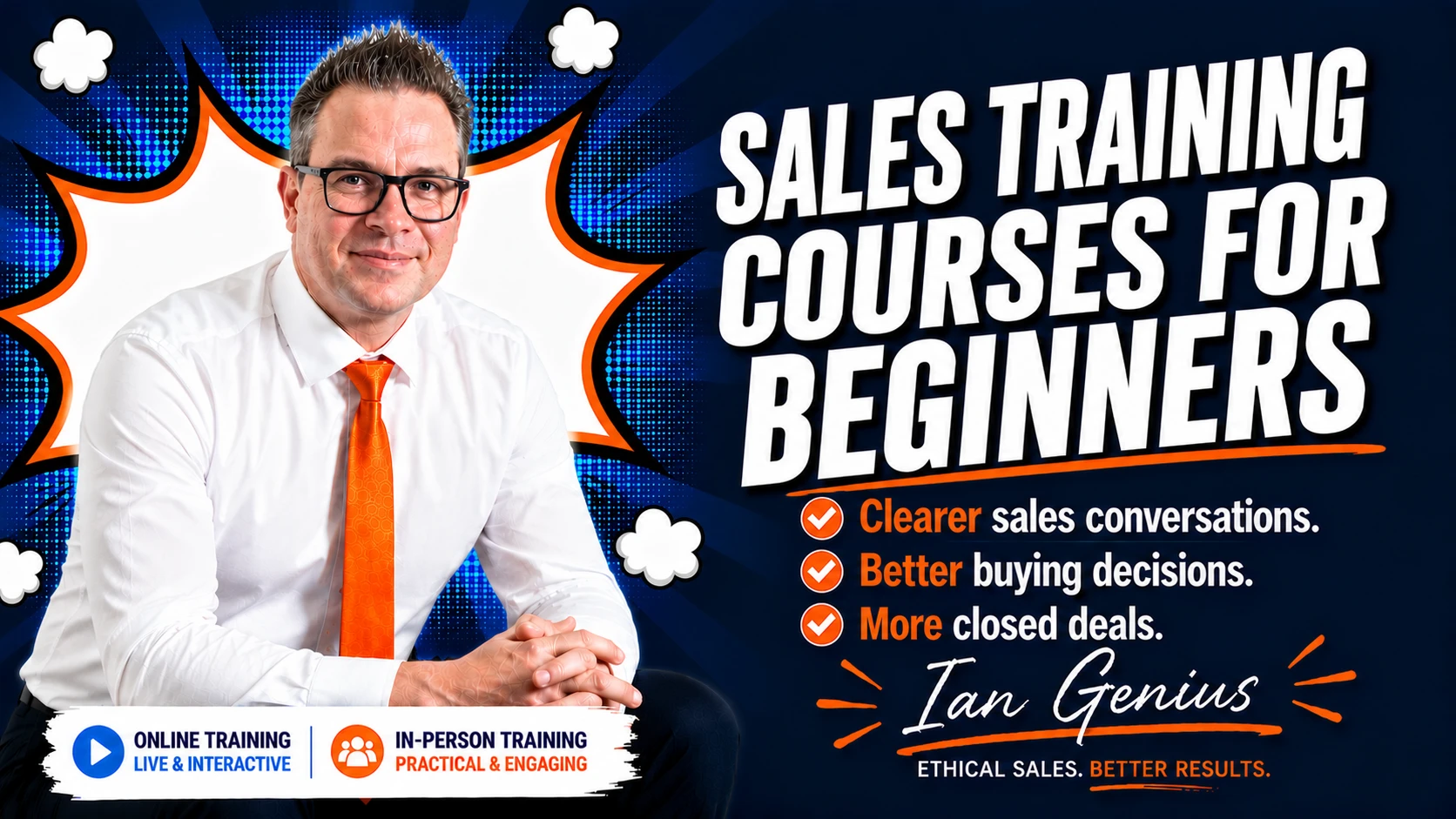
All training is delivered personally by Ian Genius, who has worked in professional sales since 1998. An initial conversation can establish what you want to change, whether online or face-to-face delivery makes sense and which programme is the best fit. If the training is not appropriate, you should be able to find that out before booking.


 Trustindex verifies that the original source of the review is Google.
 Trustindex verifies that the original source of the review is Google.
 Trustindex verifies that the original source of the review is Google.
 Trustindex verifies that the original source of the review is Google.
 Trustindex verifies that the original source of the review is Google.
 Trustindex verifies that the original source of the review is Google.
 Trustindex verifies that the original source of the review is Google.
 Trustindex verifies that the original source of the review is Google.
 Trustindex verifies that the original source of the review is Google.
 Trustindex verifies that the original source of the review is Google.
|
Turbocharge Your Sales MOST POPULAR |
Effective Sales Conversations MOST COMPREHENSIVE |
Sell on VALUE ESSENTIALS | |
|---|---|---|---|
| In-Person / Your Venue |
Call me
|
Call me
|
Call me
|
| Online Via Zoom |
Call me
|
Call me
|
Call me
|
| Demonstrate Value | ✓ | ✓ | ✓ |
| Simplify Sales Pitch | ✓ | ✓ | |
| Clarity & Confidence | ✓ | ✓ | |
| Sales Conversation | ✓ | ✓ | ✓ |
| Sales Training | 6 Hrs | 12+ Hrs | 60 Mins |
| Phone Support | ✓ |
| Sell on VALUE ESSENTIALS |
Turbocharge Your Sales MOST POPULAR |
Effective Sales Conversations MOST COMPREHENSIVE |
|
|---|---|---|---|
| In-Person / Your Venue |
Call me
|
Call me
|
Call me
|
| Online Via Zoom |
Call me
|
Call me
|
Call me
|
| Demonstrate Value | ✓ | ✓ | ✓ |
| Simplify Sales Pitch | ✓ | ✓ | |
| Clarity & Confidence | ✓ | ✓ | |
| Sales Conversation | ✓ | ✓ | ✓ |
| Sales Training | 60 Mins | 6 Hrs | 12+ Hrs |
| Phone Support | ✓ |
20-minute call. No pressure. Just see if it fits.
Prefer to write? Message Ian instead.
Sales training for beginners helps people who are new to selling learn how to have clearer conversations, explain their value and give potential clients the confidence to make a decision. You do not need a sales background or a confident, outgoing personality to get started. You need a simple approach that feels natural and works in real conversations.
These sales training courses for beginners are designed for business owners, start-up founders, new salespeople and teams building their sales skills from the ground up. Rather than teaching pushy scripts or pressure tactics, the focus is on understanding what clients need, communicating the benefits of your service and making your offer easier to buy.
A practical beginner sales course gives you a clear structure for conversations, from the first enquiry to the next step. You learn how to ask useful questions, listen to the answers and explain why your service may be right for that particular client.
Beginner sales training is suitable for small business owners, consultants, advisers, account managers, newly recruited salespeople and teams with little formal sales experience. It can also help people who are excellent at their work but uncomfortable talking about prices, explaining their services or asking clients to move forward.
Whether you speak to prospects on the phone, through Zoom or Microsoft Teams, at networking events or face to face, the same principles apply: listen properly, explain clearly and give the buyer enough information to choose with confidence.
Not necessarily. A script can make some people sound less natural, especially when a buyer asks an unexpected question. This approach to sales training for beginners focuses on understanding the conversation rather than memorising lines. You learn how to respond clearly in your own words, without pushy selling techniques.
When clients understand what you do, why it matters and what happens next, they are better placed to make a decision. Clear communication can also reduce avoidable objections and missed opportunities caused by confusion.
Yes. Sales training courses for beginners are available live online or in person, for individuals and teams. Both options focus on practical sales conversations and the situations you face in your own business. The aim is to develop skills you can use straight away, not leave you with a folder of theory.
If you are looking for your first sales training course, or want new team members to build a consistent approach, the goal is straightforward: greater confidence, clearer client conversations and more opportunities to win business without pressure.
Our Zoom sales training gives business owners and corporate sales training clients a practical way to improve sales conversations without taking time away from the business.
| Cookie | Duration | Description |
|---|---|---|
| cookielawinfo-checkbox-analytics | 11 months | This cookie is set by GDPR Cookie Consent plugin. The cookie is used to store the user consent for the cookies in the category "Analytics". |
| cookielawinfo-checkbox-functional | 11 months | The cookie is set by GDPR cookie consent to record the user consent for the cookies in the category "Functional". |
| cookielawinfo-checkbox-necessary | 11 months | This cookie is set by GDPR Cookie Consent plugin. The cookies is used to store the user consent for the cookies in the category "Necessary". |
| cookielawinfo-checkbox-others | 11 months | This cookie is set by GDPR Cookie Consent plugin. The cookie is used to store the user consent for the cookies in the category "Other. |
| cookielawinfo-checkbox-performance | 11 months | This cookie is set by GDPR Cookie Consent plugin. The cookie is used to store the user consent for the cookies in the category "Performance". |
| viewed_cookie_policy | 11 months | The cookie is set by the GDPR Cookie Consent plugin and is used to store whether or not user has consented to the use of cookies. It does not store any personal data. |
Tell me a little about your business, the sales challenges you’re facing and what you’d like to achieve. I’ll reply to you personally. (Normally within the hour)