
Want to see how online sales training can help teams simplify offers without sounding pushy?
Introduction of Saying No to Small Clients
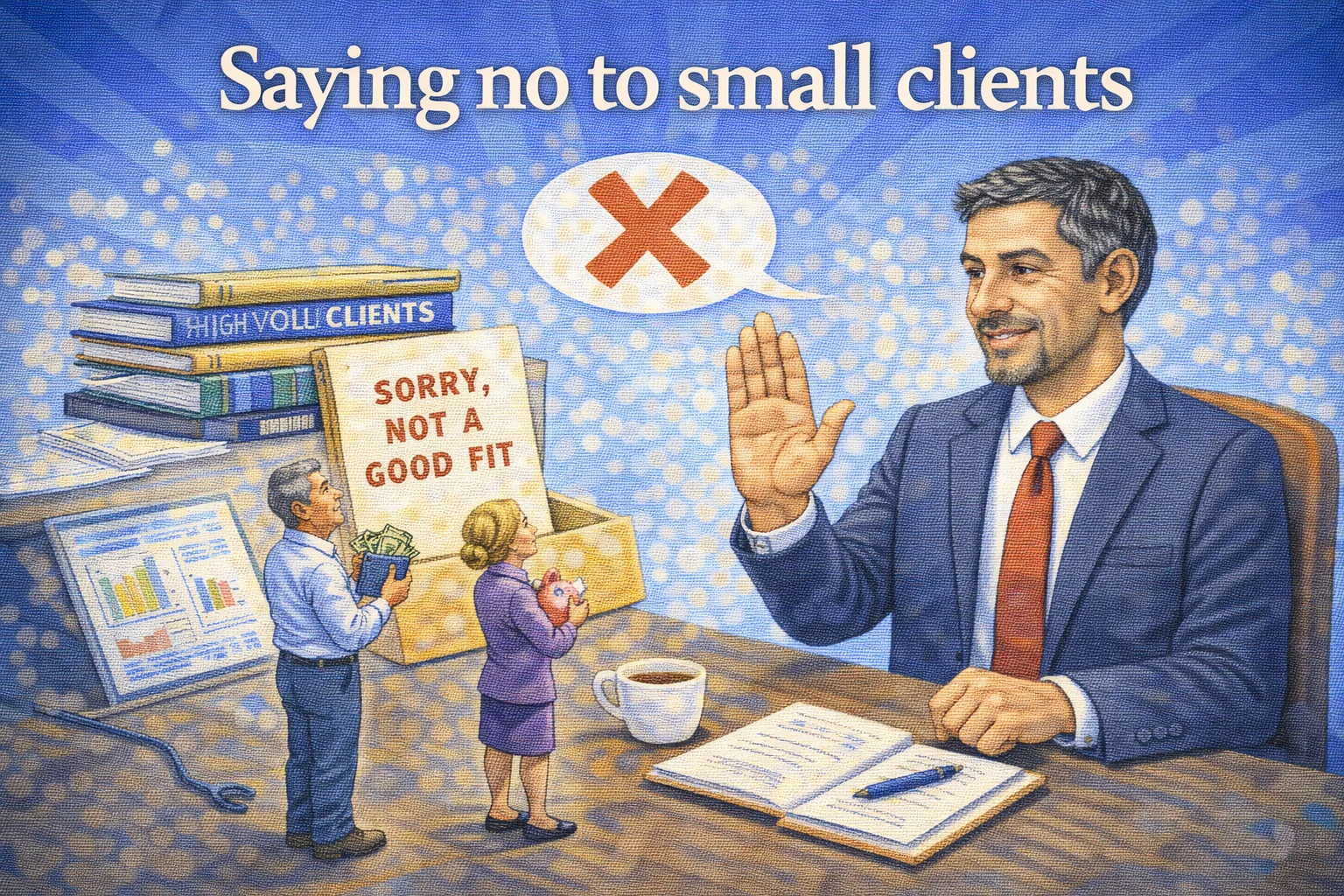
Saying no to small clients can feel like stepping on a rake. You know it is needed. But you still worry about the fallout. This article shows you how to do it without panic.
You might be busy all day and still feel behind. Tiny cases can swallow your diary. Low fees can still mean high service. This is where turning away smaller clients becomes a business skill, not a personality flaw.
Maybe you have a few early clients you like. But you resent the work. And then you feel guilty for resenting it. Here you will learn how to set clear limits and keep your standards intact.
If you keep saying yes to every low value enquiry, your best clients pay the price. Your advice quality drops. Your energy drops. This guide gives you words, boundaries, and a clean process for declining small cases.
As this is what Forbes advisers say about ending poor-fit relationships to protect service quality and long-term retention, many firms strengthen client loyalty by investing in sales training that improves conversations before relationships drift.

What Small Clients Means When You Are Saying No to Small Clients
Small does not always mean a low portfolio number. It can mean low fees, low scope, or low complexity. It can also mean a case that stays small because nothing ever happens. Saying no to small clients starts with a definition you can stick to.
Some firms define small by assets. Others define it by an annual fee. Many miss the real driver, time per pound earned. If two clients pay the same but one takes four times the chasing, the “small” one is the time heavy one.
A small client can look fine on day one. Then it becomes a drip feed of calls, emails, and what if questions. That is still a small case in practice, even if the money looks decent. Declining low fee clients is easier when you name this pattern early.
There are also “high anxiety” clients. They need constant reassurance. They delay decisions and want you to carry the worry for them. These are often the smallest in outcome and the biggest in load.
The Cost of Keeping Small Clients When You Need to Say No
The cost is rarely the meeting. The cost is everything around it. Admin, compliance tasks, research time, and follow ups stack up fast. Saying no to small clients is often a time rescue plan.
Look at your last ten “small” relationships. Count the emails, the calls, the reschedules, and the chasing. Then count the time you spent thinking about them between tasks. That invisible mental load is real.
Capacity is not a feeling. It is maths. If you can properly serve a limited number of households, every extra small case steals space from the people who value you most.
When your calendar is full, you start rushing. You shorten prep. You shorten thinking time. And then clients sense it, even if you do not say it.
Cross funding sounds noble. It can also trap you. You tell yourself the bigger clients cover the smaller ones, but the smaller ones still drain your best hours.
When that drain gets big enough, growth slows. Referrals get weaker. Your service model turns into a patchwork. And your pricing confidence cracks.
Why Advisers Struggle With Saying No to Small Clients
Early clients can feel like family. They backed you when you were new. So you feel you owe them forever. Saying no to small clients becomes an emotional test, not a business choice.
Loyalty is a good trait. But unlimited loyalty is a business risk. You can honour the relationship and still change the service level. That is not betrayal, it is maturity.
The fear of reputational damage is common. You picture a bad review or awkward conversations in your local network. So you delay the decision and hope the issue fixes itself.
Most reputational harm comes from poor communication, not from a boundary. If you are clear, respectful, and helpful with next steps, people usually accept it. The issue is vagueness, not firmness.
Guilt and people pleasing are sneaky. You tell yourself you are being kind. But you are also avoiding discomfort. Declining smaller clients gets easier when you notice that loop.
You can feel caring and still say no. Kindness is not the same as keeping everyone. And it is not your job to be the answer for every budget.

What Clients Hear When You Say No to Small Clients
Clients do not hear your business model. They hear rejection. They may assume they are not “good enough” for advice. Saying no to small clients needs care because the first reaction is often emotional.
Some people feel shame. Some get angry. Some go quiet. All three can happen even when you are polite.
Decision paralysis can kick in fast. They already feel unsure about money. If they sense judgement, they freeze and delay everything.
They may also start bargain hunting. They move from adviser to adviser asking for exceptions. That usually ends in no action and more stress.
You can lower threat with language. Use calm, simple reasons. Offer a clear next step that still helps them move forward.
Do not over explain. Do not defend your fees like you are on trial. Keep the tone steady and focused on outcomes.
UK Fairness and Duty When Saying No to Small Clients
In the UK, you must think about foreseeable harm. You must also be clear and fair in how you treat people. Saying no to small clients should fit a consistent policy, not mood based decisions.
Consumer Duty pushes firms to consider how clients experience your service. If someone leaves you confused or stranded, that can be a problem. So your process needs a safe landing.
Be careful with “orphan clients”. These are people left with little service or unclear support. If you change your model, make sure clients know what happens next and what you will still do, if anything.
Document your decisions. Not with long essays. Just enough to show your line and the reason. Consistency protects you.
A clear minimum is often more fair than ad hoc exceptions. People can dislike a boundary and still respect it. People struggle more with “maybe”.
When you are consistent, staff also feel safer. They know what to say. They stop negotiating on your behalf.
Setting Minimums for Saying No to Small Clients
You need a line in the sand. It can be a minimum fee, a minimum assets level, or a minimum scope. Saying no to small clients is simpler when the rule is plain.
A minimum fee is often the cleanest. It links to the service you provide, not the client’s status. It also avoids awkward asset comparisons.
A minimum assets figure can work, but it can feel blunt. It also fails when a client has assets but low engagement or no willingness to act. That is why behaviour still matters.
Exceptions can be sensible. But only when they have a time limit and a reason you can repeat. Otherwise you create a loophole that spreads.
If you say yes “just this once” too often, the rule collapses. And your team learns that the real minimum is whatever the prospect complains about.
A tier model helps. It gives smaller cases a lighter service, with clear boundaries. It also gives you an upgrade path when they grow.
You are not forcing anyone. You are offering choices. And you are protecting the quality of advice for every client you serve.
Better Options Than Simply Saying No to Small Clients
Graduating a client can be kinder than ending things. You explain that your firm has grown and your service has changed. Saying no to small clients can still include a supportive route forward.
A lighter service might mean one annual review and limited contact. It might mean fewer planning areas. The key is clarity on what is included and what is not.
It also helps to make it feel normal. This is a service level change, not a moral judgement. And it gives the client dignity.
On demand or hourly work can fit some people well. It suits those who want a one off plan or a specific answer. It also stops open ended support draining your week.
The pricing must be plain. The scope must be tight. And you must say what happens after the session, so it does not become endless follow up.
Referring a client can protect goodwill. It shows you still care about the outcome. Declining low value enquiries lands better when you hand them to a good fit.
Choose referral partners you trust. Brief them properly. And tell the client why that person suits their needs.
Digital or hybrid help can be right for smaller pots. It can give guidance at a lower cost. It can also keep them moving instead of freezing.
Be careful with promises. Make sure you describe what it can and cannot do. Clear expectations stop complaints later.
Selling or transferring a block can work in some cases. It is more common where you have a large set of similar relationships. It can free capacity in one move.
But it needs care. Clients dislike feeling like stock. If you go down this road, the communication must be respectful and transparent.

How to Choose Which Small Clients to Move On First
You need a method, not a mood. Start with a simple view of value and behaviour. Saying no to small clients is less stressful when you follow a repeatable test.
Segment by outcomes, not just assets. Look at who acts on advice. Look at who pays on time. Look at who respects boundaries.
A “small” client who acts fast and needs little chasing can be easy to serve. A higher paying client who drains time can be harder. That is why behaviour based sorting matters.
Red flags show up early. Constant rescheduling is one. Endless “quick questions” is another. Refusing to share documents is a big one.
Some clients treat advice like a hotline. They want certainty you cannot give. If that pattern is strong, you may need to move them to a different service.
A scoring sheet helps. Keep it short. Time demand, responsiveness, complexity, and fit. Then add a note on risk and stress.
This makes decisions fair. It also reduces second guessing. And it helps you explain the decision if needed.
How to Say No to Small Clients Without Fallout
You need a structure for the conversation. Truth, reason, next step. Saying no to small clients is easier when you do not ramble.
Start with the truth. Keep it calm. Then give one clear reason linked to your service model and capacity.
Next, give them a path. A referral. A lighter service. Or an hourly option. People cope better when they have a direction.
Use “right fit” language. It reduces status threat. It also keeps the tone professional rather than personal.
Avoid blame. Avoid telling them they are “too small”. Avoid comparing them to other clients. Just state your minimum and your model.
Do not talk yourself into a discount. Silence can feel awkward, but it is part of firmness. If you fill the silence, you may start negotiating.
A Smooth Plan for Saying No to Small Clients
Do not do it all at once. Work in waves. Saying no to small clients in batches protects your diary and reduces drama.
Pick a small group first. Test your scripts. Learn what questions come back. Then refine your process.
Set a timeline. When you will tell them. When the change takes effect. What support you offer in the handover window.
Keep comms consistent. Email can work, but some clients need a call. Choose based on relationship history and sensitivity.
Track it like a project. Who has been told. Who has agreed. Who needs follow up. That prevents loose ends.
Expect pushback. Some will ask for an exception. Have a calm line ready. Repeat the rule and return to the next step.
Stop Small Clients Joining in the First Place
Front end screening saves months of pain. Ask better questions early. Saying no to small clients becomes less common when your filter is strong.
Use a short discovery call. Confirm budget fit, scope fit, and urgency. If they cannot decide or cannot commit to action, that tells you a lot.
Values fit matters too. Some people want constant reassurance. Some want a quick answer without doing the work. You want clients who share responsibility.
Set expectations before they sign. Explain response times. Explain what “advice” includes and what it does not include. That stops false assumptions.
A simple prospect form can help. It reveals complexity and readiness. It also stops you wasting time on low intent enquiries.
When your positioning is clear, better fit clients find you. And the wrong fit self selects out.
The Upside of Saying No to Small Clients
Your diary gets cleaner. Your prep time returns. Saying no to small clients often gives you the first deep breath you have had in months.
Your best clients notice the change. You reply faster. You think more clearly. And your meetings feel calmer and more focused.
Your positioning sharpens. Your minimum fee starts to feel normal. Prospects treat you with more respect when you respect your own model.
Referrals can improve too. People refer to you when they know who you are for. Confused positioning creates mixed referrals.
You also drop resentment. That matters more than most advisers admit. Resentment leaks into tone and patience.
Confidence grows. Pricing becomes easier to say. And your advice quality rises because you have space to do it properly.
FAQ on saying no to small clients for financial advisers
What is the simplest way for financial advisers to say no to a small client enquiry?
Financial advisers should keep the message short and link it to their service model rather than the client’s situation. Explain that you work to a minimum fee or scope so you can deliver a consistent level of service to every client. Then offer a clear alternative such as a referral, a one off session, or a lower cost route. Sales training helps financial advisers handle these conversations with confidence so the message feels professional and fair.
Should financial advisers use a minimum fee or a minimum assets level?
For financial advisers, a minimum fee is often clearer because it reflects the work involved rather than the portfolio size. A minimum assets level can feel blunt and may not reflect complex cases that require significant time. Many firms combine a fee minimum with scope and behaviour fit checks. Sales training helps financial advisers explain these criteria clearly so prospects understand the structure and accept the boundary.
How can financial advisers protect their reputation when declining smaller clients?
Financial advisers should be respectful, specific, and avoid long explanations that sound defensive. Offer a helpful alternative so the person still feels supported rather than rejected. Keep the wording consistent so the decision is seen as policy, not personal judgement. Sales training helps financial advisers deliver difficult messages in a calm, client centred way that protects trust and referrals.
Nationwide Sales Training For Ambitious B2B Teams
If you’re investing in nationwide sales training, your programme should reflect your industry, buyers and commercial goals. From my base in Mansfield, I help organisations across Nottingham, London and throughout the UK, delivering practical workshops on-site or through sales training online.
Specialist programmes include financial services sales training, mortgage adviser sales training, insurance sales training, sales training for software companies, technology sales training and telecommunications sales training. I also deliver sales training for corporate teams that helps businesses simplify complex sales conversations, communicate value more effectively and convert more opportunities.
See how Master Your Pitch can help prospects understand why they should choose you.
Ready to improve your sales conversations? Book a call and let’s find the right programme for your business.

Other Useful FAQs
How do you structure a first meeting so prospects become clients?
First meetings often feel positive but lead nowhere. This article explains how to structure the conversation so prospects feel clear, confident, and ready to move forward. Read how to structure a first meeting so prospects become clients.
Why don’t prospects see the value of financial advice?
The benefits of advice often feel invisible to clients. This article explains why prospects struggle to see value and how advisers make outcomes clear and tangible. Read why prospects don’t see the value of financial advice.
How do you explain your value so clients will pay your fees?
Fee resistance usually comes from unclear value, not price. This article shows how advisers explain their impact so clients understand what they’re really paying for. Read how to explain your value so clients pay your fees.
How can advisers increase fees or minimums without losing clients?
Raising fees feels risky when you expect pushback. This article explains how advisers increase prices confidently while keeping trust and retention high. Read increase fees or minimums without losing clients.
How do you get more referrals without asking awkwardly?
Most advisers avoid referral conversations because they feel uncomfortable. This article explains how to generate introductions naturally without sounding needy. Read get more referrals without asking awkwardly.
Should financial advisers specialise in a niche, and how do you choose one?
Niches reduce competition but choosing one feels risky. This article explains when specialising makes sense and how advisers decide where to focus. Read should advisers specialise in a niche.
What prospecting strategies help advisers win ideal clients?
Busy advisers often rely on inconsistent lead sources. This article explains practical prospecting approaches that attract better fit clients consistently. Read prospecting strategies that win ideal clients.
How do you build a referral engine instead of relying on chance?
Referrals often happen randomly, not predictably. This article explains how advisers create a simple system that generates introductions consistently. Read building a referral engine for advisers.
How does client understanding increase conversion?
Clients don’t act when they don’t fully understand the recommendation. This article explains how clearer client understanding leads to faster and more confident decisions. Read client understanding that converts.
What’s the easiest way for advisers to win new clients?
Winning new business doesn’t require more activity, it requires clearer positioning and conversations. This article explains the simplest way to attract and convert new clients consistently. Read how to win new clients the easy way.
How can financial advisers attract younger clients?
Younger prospects don’t respond to traditional messaging. This article explains what attracts them and how advisers adjust their approach to engage this audience. Read attracting younger clients fast.
How do you handle client objections and still build trust?
Objections aren’t resistance, they’re uncertainty. This article explains how advisers respond in a way that increases confidence instead of creating pressure. Read handling client objections and building trust