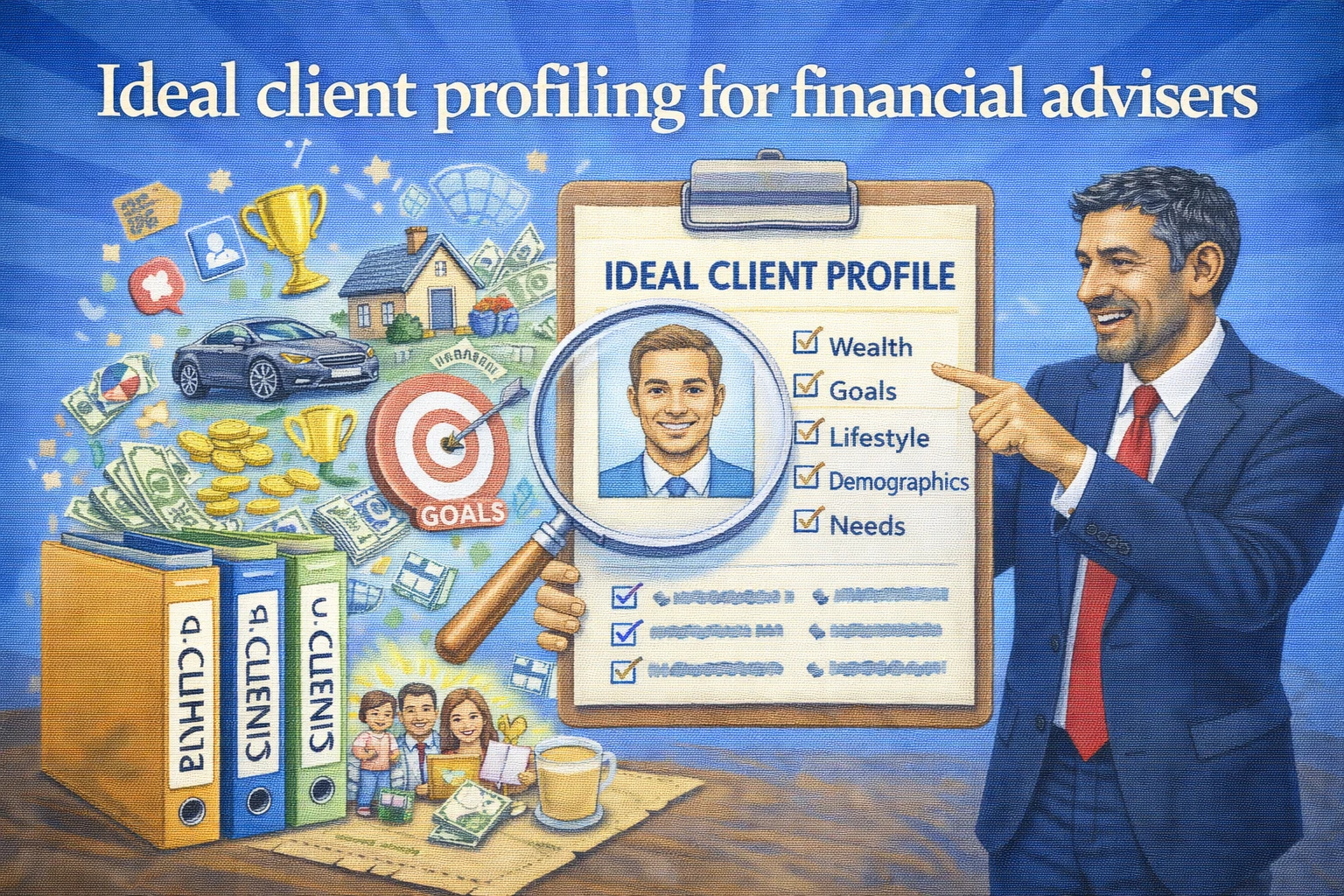
Introduction to Ideal Client Profiling.
Ideal client profiling is the difference between a calendar full of good calls and a week of time wasted. You can do everything right and still attract people who stall, haggle, or never reply. That is not a marketing problem. It is a fit problem.
Most financial advisers say they want better clients. But their message is broad, so anyone can book a call. Ideal client profiling fixes that by making “right fit” clear, early, and easy.
If your pipeline is full but revenue feels stuck, your client mix is often the reason. You may be meeting people who are polite, but not ready, not aligned, or not suitable for your service. Ideal client profiling helps you spot that before you spend hours on it.
This article shows you how to profile your best clients, turn patterns into a clear client profile, and use it in real adviser client conversations. You will reduce ghosting, reduce decision paralysis, and attract people who value advice. Ideal client profiling is not about being picky. It is about being precise.
For financial advisers focused on long term growth, this is what Forbes Finance Council advisers say about improving retention – consistent communication, clear value, and defined client experience build loyalty – and structured sales training helps turn ideal client fit into stronger, longer relationships

Ideal client profiling, what it is and what it is not
Ideal client profiling is a clear description of who you help best and why. It is not a vague wish list, and it is not a “nice to have” document. It is a working tool you use in marketing and in calls.
A strong ideal client profile sets boundaries. It says who you are for, who you are not for, and what “good fit” looks like in plain English. That clarity supports better outcomes and smoother advice journeys.
Some advisers mix up an ideal client profile with a target market. A target market can be wide and still useful for reach. Ideal client profiling is narrower, because it is built around fit, behaviour, and outcomes.
A niche can be part of your profile, but it is not the whole thing. A niche might be doctors, business owners, or retirees. Your ideal client profile explains why those people choose you, how they decide, and how they like to work.
Many advisers create a persona and stop there. Personas can be helpful for content tone, but they often lean on stereotypes. Ideal client profiling goes deeper into needs, decision style, and trust signals.
The real goal is simple. Fewer poor fit enquiries, more right fit clients, and cleaner conversations. That is what a good profile gives you.
Ideal client profiling, why it changes the quality of your clients
Ideal client profiling improves the quality of clients because it filters before the first call. People self select when they can see themselves in your message. And poor fit people often drop off, which is a win.
When fit is clear, your advice lands better. Clients engage, respond, and follow through. That means fewer false starts and fewer “I will think about it” loops.
A good fit client gets better outcomes. They share better data, act sooner, and stay calm under pressure. Your planning becomes simpler because you are working with people who want to work with you.
Poor fit clients create noise. They drain time, increase stress, and slow your team down. Ideal client profiling reduces that cost by reducing the number of mismatched conversations.
It also shortens decision time. People who match your profile tend to trust process and value clarity. They are less likely to freeze, delay, or vanish after the first meeting.
Referrals get better too. When clients can describe who you help, they refer people like them. That makes your pipeline stronger without more content, ads, or events.
Ideal client profiling, start with your best existing clients
Start by picking your top 10 clients. Choose people who value the work, pay without drama, and get results. Ideal client profiling works best when it begins with reality, not guesswork.
Look for clients you enjoy serving. Enjoyment matters because it affects your energy and your standard. Better energy leads to better meetings, and better meetings lead to better outcomes.
Now pull the hard facts. Life stage, family setup, career type, business ownership, and financial complexity often show patterns. Write only what truly links to fit.
Also pull financial details that shape the work. Typical income range, assets, protection needs, tax issues, and time demands can all matter. Keep it specific, but not so narrow you exclude good fits.
Then look at behaviours. How fast do they reply. Do they show up prepared. Do they act on agreed actions. These signals often predict future success more than net worth does.
Finally, look at the relationship. Do they trust you early. Do they ask good questions. Do they want clarity, not hype. Ideal client profiling should reflect how it feels to work with them.

Ideal client profiling, patterns that predict a good fit
Decision style is often the hidden factor. Some clients decide fast when they see a clear plan. Others need certainty and repeat checks, which can be fine if they still move.
Buying behaviour shows up early. Do they ask about outcomes, or only fees. Do they compare you to a spreadsheet, or to a trusted guide. Those clues tell you how they make financial decisions.
Many people carry emotional triggers into advice. Fear of loss, fear of looking foolish, and fear of making the wrong call drive delay. Your ideal client profile should name the emotional drivers you handle well.
Some clients want control and detail. Others want calm and a clear next step. Both can be good fits, as long as expectations match your way of working.
Trust signals vary. Some people need proof, such as case studies, qualifications, or a clear process. Others need human trust, such as honesty, plain language, and steady guidance.
Watch what builds confidence in the first call. If your best clients relax when you simplify, that is a key pattern. Ideal client profiling should capture what earns trust quickly.
Communication preferences matter more than many advisers think. Some clients want detail and longer meetings. Others want short updates and a clear action list.
Also note pace and channel. Email, phone, video, and in person can change engagement. When your style matches theirs, the relationship stays steady and decisions are easier.
Ideal client profiling, build your ideal client profile
Demographics can help, but only when they link to the work. Age can matter because it links to stage of life. Location can matter if you work with local business networks.
Avoid fluff demographics. “Male or female” rarely changes advice needs. “Likes golf” is not a fit factor unless it links to referral routes you truly use.
Now define the financial reality. What problems do they face. What complexity do they bring. And what time pressure do they live with. Ideal client profiling should mirror real life, not a brochure.
Be clear about constraints. Some clients have messy finances and need order. Others have strong finances and need strategy. Both can fit if you deliver the right service.
Values and beliefs about money shape behaviour. Some people value security above all else. Others value freedom, legacy, or control. Your profile should match the type of value you deliver.
Beliefs also show up as phrases. “I do not trust banks” or “I just want to keep it simple” tells you what they need from you. That helps you frame advice in ways they accept.
Goals matter most when they are urgent and meaningful. Retirement confidence, business exit, inheritance planning, and tax clarity are common. The key is whether they will act to reach the goal.
Tie goals to why they will pay. People pay for relief, direction, and confidence. Ideal client profiling should include the outcomes they value, not just the products they need.
Compatibility is the final layer. Do they accept your process. Do they want a partner, not a rescuer. Do they respect boundaries and timelines.
Also define what a good relationship looks like. Frequency of contact, level of involvement, and decision ownership all matter. A great profile makes those expectations visible.
Ideal client profiling, add disqualifiers so you stop attracting the wrong people
Disqualifiers protect your time and your team. Ideal client profiling is not only about who you want. It is also about who will harm the work.
Start with red flag behaviours. Missed calls without notice, aggressive fee pressure, and constant second guessing are warning signs. One sign is not always fatal, but patterns are.
Look for time wasting signals early. People who demand complex work before any commitment often do not value advice. People who want guarantees often struggle with reality.
Now name misalignment red flags. If they expect daily contact but you work quarterly, that will break. If they want quick fixes but you focus on long term planning, that will break too.
Fees are a common misalignment. Some people want premium work at budget price. It is better to spot that early and end the conversation with respect.
There are times to refer out. If a client needs specialist tax work you do not offer, refer. If their needs are better served by another advice model, refer.
And sometimes the right answer is no. A polite no can save months of stress. Ideal client profiling gives you the language to say no without guilt.

Ideal client profiling, a simple scoring system for fast qualification
A fit score helps you stay objective. It stops you falling for charm, urgency, or pressure. Ideal client profiling becomes easier to use when you can rate fit fast.
Keep it simple. Five factors are enough. Use words your team can repeat and apply in real calls.
Need fit asks one thing. Do they have problems you solve well. If not, even a nice client will become a poor fit over time.
Need fit also checks scope. If they need work outside your service, the relationship starts with disappointment. That is avoidable with clear boundaries.
Value fit is about what they care about. Do they value clarity, planning, and steady progress. Or do they want shortcuts and hype. Your message should attract the first group.
Value fit also covers expectations. If they want you to do everything while they do nothing, that is not a fit. A good client shares the work.
Behaviour fit looks at follow through. Do they reply, show up, and act. Behaviour is a strong predictor of outcomes, so it belongs in ideal client profiling.
Behaviour fit also picks up decision style. Slow is fine if it moves. Frozen is not fine if it never moves.
Trust fit is about how they build confidence. Do they accept your process. Do they listen and ask thoughtful questions. Or do they resist every step.
Trust fit also checks respect. Respect for your time, your advice, and your role matters. Without that, the relationship becomes a fight.
Economics fit means the work makes sense for both sides. Can they pay your fee without strain. Does the case justify the time and the team effort.
Economics fit is not only about assets. It is about complexity, urgency, and value. Some lower asset cases are high impact and still fit well.
Now define what scores mean. A high score is a clear yes. A mid score is a maybe, with conditions. A low score is a no, with a clean referral route.
Use the score quietly. Do not talk numbers to the client. Use it as an internal guide so your recommendations stay consistent and fair.
Ideal client profiling, turn your profile into plain English messaging
Your profile should shape a one sentence positioning line. It should say who you help, what you help them achieve, and why it matters. Keep it crisp and human.
Ideal client profiling makes this easier because you stop speaking to everyone. Your words become sharper because they are for a real person with a real problem.
Next, write the problem they feel. Not the technical issue. The emotional experience. Stress, doubt, overwhelm, and fear of making a mistake are common.
Use phrases clients use. “I feel behind” or “I do not know what to do next” is more powerful than finance jargon. This improves client understanding fast.
Then write what you do in outcome language. Simple plans, clearer choices, fewer worries, and better decisions. Keep it direct and avoid buzzwords.
Also be clear about how you work. Process builds trust in financial advice. People relax when they can see the steps.
Now gather proof points. Real outcomes, clear credentials, and client stories build confidence. Even small proof can help, as long as it is true and specific.
Proof should match your ideal client profile. If your best clients value clarity, show clarity. If they value calm guidance, show calm guidance.
Ideal client profiling, use it in adviser client conversations
Use your profile in discovery without making it feel like a checklist. Ask questions that reveal needs, values, and decision style. And listen for emotional cues.
Ideal client profiling should guide what you ask next. If someone shows decision paralysis, you explore what drives it. If they show urgency, you test whether it is real.
Good discovery questions feel natural. “What would make this feel like progress” works well. “What have you tried already” shows respect for their history.
Also ask about preferences. “Do you prefer detail or the headline” helps you match your communication style to theirs. That alone can reduce friction.
Decision paralysis is common in financial decision making. People fear regret and want certainty that does not exist. Your job is to reduce confusion and offer a clear next step.
Use short options. Give two or three clear choices, not ten. And check understanding with plain language.
Explaining complex advice means you translate, not impress. Use short sentences and simple examples. If they cannot repeat it back, it is not clear yet.
Tie complex points back to what they care about. Time, peace of mind, family security, and freedom are usually the real drivers. That is how you support better decisions.
Know when to recommend. Recommend when fit is clear, goals are clear, and data is good enough to act. Do not wait for perfect certainty, because it rarely comes.
Know when to pause too. Pause when trust is not there, when the client is overwhelmed, or when the scope is unclear. Ideal client profiling helps you spot those moments early.
Ideal client profiling, where to use it in your marketing
Your website should reflect your ideal client profile. Say who you help, what you help them do, and what a good fit looks like. This is financial adviser positioning in action.
Also say who you are not for. That can feel risky, but it saves time and improves enquiry quality. It makes your message believable.
Your bio should match your profile too. Avoid generic claims. Use simple language that your ideal client would use.
Mention how you work and what clients can expect. Clear financial messaging builds trust before a call even happens. That reduces wasted meetings.
Content topics should pull your ideal clients in. Write about the problems they feel, the decisions they delay, and the outcomes they want. This connects to buying behaviour and decision paralysis.
Keep content practical. Focus on choices, trade offs, and clarity. Ideal client profiling gives you a topic filter so you stop chasing random ideas.
Referrals and partner routes work best when your profile is clear. Accountants, solicitors, and mortgage brokers refer better when they know your fit. Give them a simple description they can repeat.
Make it easy for partners to say, “This adviser is for people like you.” That single line can increase referral quality without more meetings.
Events and communities matter. Go where your ideal clients already spend time. For business owners it may be local business groups, trade bodies, or founder networks.
Choose one or two channels and be consistent. Ideal client profiling stops scattergun marketing. It keeps you focused on the people you serve best.
Ideal client profiling, keep it accurate over time
Your profile should be reviewed often. Markets change, life stages shift, and your service evolves. Ideal client profiling is a living tool, not a one time task.
A simple review every 6 to 12 months is enough for most advisers. Look at what worked, what felt hard, and what you want more of.
Track a few key signals. Conversion rate matters, but so does time to decision. Also track cancellations, scope creep, and stress in the relationship.
Look at what causes delays. If many clients stall at the same point, your message or process may be unclear. Fixing that can lift results quickly.
Sometimes you need two profiles. One for core clients, one for a specialist offer. That is common when you serve both accumulation and retirement planning.
Split only when the needs and messaging are truly different. Too many profiles creates confusion. The goal is clarity, not complexity.
FAQ on ideal client profiling for financial advisers
What is ideal client profiling for financial advisers and why does it matter?
For financial advisers, ideal client profiling means defining the types of clients you serve best based on real patterns from your strongest relationships. It matters because it reduces poor fit enquiries and improves conversion and retention. When you attract clients who value advice and follow through, outcomes improve for both sides. Sales training helps financial advisers communicate who they help and why, so the right clients recognise the fit early.
How can financial advisers build an ideal client profile without focusing only on wealth?
Financial advisers should look beyond assets and study behaviour, needs, and decision style. Start with your best clients and identify shared attitudes, complexity levels, trust signals, and communication preferences. Strong profiles are built around mindset and engagement, not just portfolio size. Sales training helps financial advisers spot these patterns and reflect them clearly in their messaging and conversations.
How can financial advisers use ideal client profiling in the first call without sounding salesy?
Financial advisers should use the profile as a guide for better questions rather than a rigid script. Ask about goals, priorities, past decisions, and what helps the client feel confident. This helps you assess fit while keeping the conversation natural and supportive. Sales training helps financial advisers handle weak fit situations calmly and professionally, including when to refer prospects elsewhere.
Sales Training UK For Ambitious Sales Teams
If you’re searching for sales training for UK teams, I deliver practical programmes tailored to your products, buyers and commercial goals. Based in sales training Mansfield, I regularly work with businesses looking for Nottingham sales training, sales training in London and organisations across the UK. Training is available on-site or through online sales training.
I provide specialist sales training for financial advisers, sales training for mortgage advisers, sales training for insurance brokers, SaaS sales training, IT sales training and telecoms sales training. Businesses also choose corporate sales training to improve sales conversations, communicate value more clearly and increase conversion rates without pressure.
Find out how Master Your Pitch can help prospects understand your value from the very first conversation.
Ready to improve your team’s results? Book a call and let’s discuss the best programme for your business.