Want to see how online sales training can help teams simplify offers without sounding pushy?
Introduction to scaling from solo adviser to firm
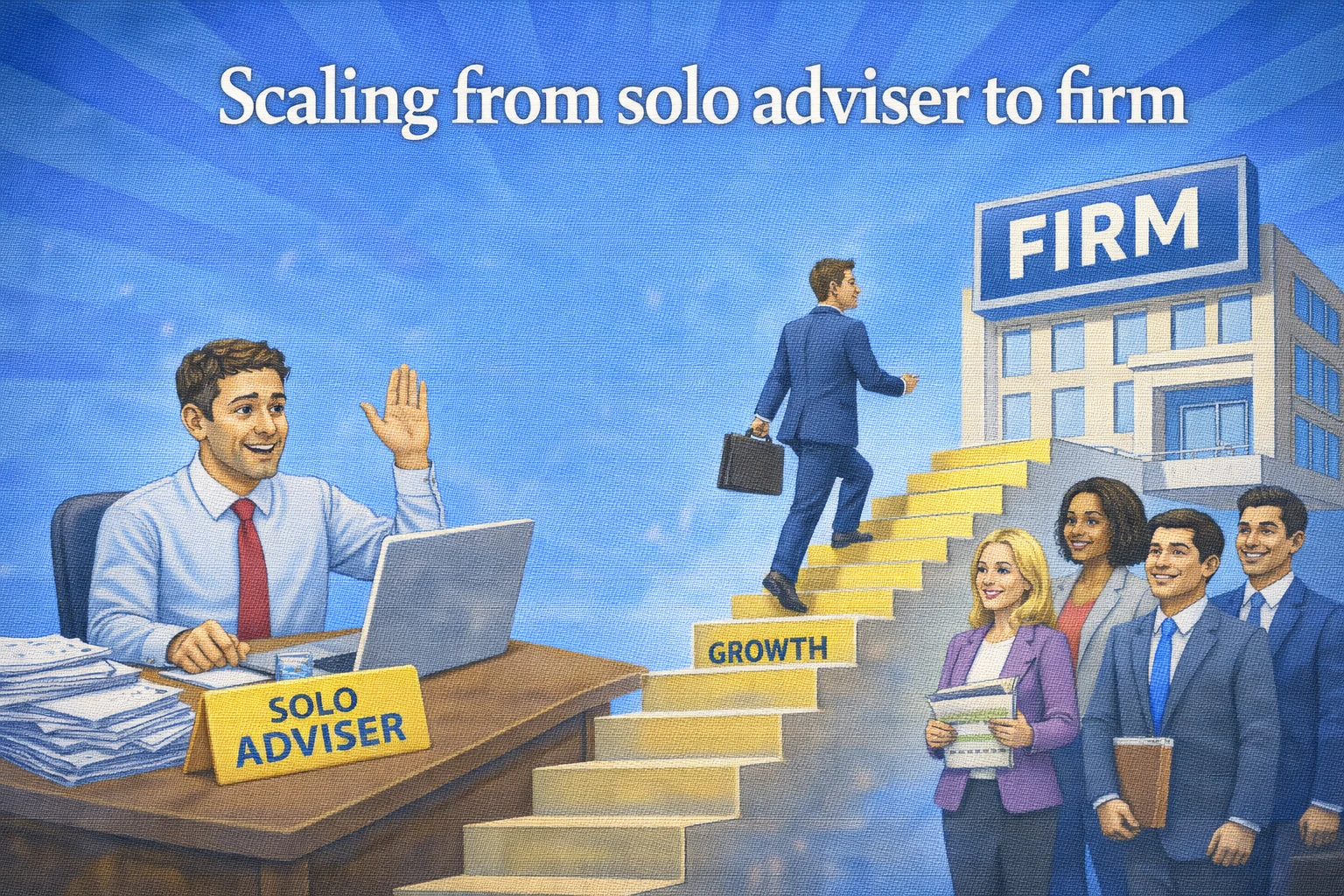
You are winning clients. But your diary is full and your head is fuller. Scaling from solo adviser to firm starts when good service begins to feel fragile.
You might be the bottleneck. Every decision waits for you. Moving from a solo adviser practice to a financial advice firm fixes that by spreading work across a clear team flow.
You may worry that growth will harm advice quality. Or that clients only trust you, not a team. Scaling from solo adviser to firm works when your client journey stays consistent, even when you are not in every meeting.
This article shows you the path from solo to firm, without guesswork. It covers hiring order, systems, compliance, and client communication. Scaling a financial adviser business is simpler when your numbers, roles, and message are clear.
This is what financial advisers say about retention and growth: consistent communication and proactive service are central to keeping clients long term, as noted by Forbes Finance Council in this is what financial advisers say about retention and growth, and firms that reinforce this with focused sales training tend to see stronger client loyalty and lifetime value.

Decide what “firm” means for you
Scaling from solo adviser to firm starts with a definition. Do you want a lifestyle business, a partner led practice, or a bigger firm with managers. Each choice changes your service promise, your fee model, and your daily work.
A firm is not just people in seats. It is a repeatable client experience. Decide what must stay personal, and what can be done by others with the same standard.
The real difference between growth, delegation, and scaling
Scaling from solo adviser to firm is not the same as getting busier. Growth can add revenue while your workload rises too. Delegation can remove tasks, but it can still leave you as the decision centre.
Scaling in financial advice means the service can expand without breaking. It needs clear roles, shared standards, and work that moves without you pushing it. If your process only works when you are present, you have a practice, not a firm.
Spot the warning signs you are hitting the solo ceiling
Scaling from solo adviser to firm often starts with small cracks. Replies take longer. Reviews get squeezed in. Admin tasks creep into evenings, and mistakes feel more likely.
You might also notice slower decisions. You keep weighing tech, hires, and pricing. This is decision paralysis, and it keeps you stuck at the solo stage while demand keeps rising.
Run the numbers before you hire
Scaling from solo adviser to firm needs maths, not hope. Start with capacity. How many clients can your current service model handle without rushed meetings, late follow ups, or rework.
Then test affordability. A hire is not just salary. It is recruitment time, training time, and a ramp up period before they save you hours or add output. If the numbers do not work yet, adjust fees, client mix, or service design before you add cost.

Pick your scaling path, three common models
Scaling from solo adviser to firm can follow different routes. One route is upmarket. You serve fewer clients, charge more, and go deeper on planning, tax, and long term outcomes.
Another route is team capacity or system led delivery. Team capacity adds advisers and support so more clients can be served. System led growth fixes workflow first, so each new person steps into a stable process instead of chaos.
Design your offer so it can be delivered by a team
Scaling from solo adviser to firm fails when the offer lives only in your head. Write down what you do, who it is for, and what “good” looks like. Keep outcomes consistent, so clients know what to expect at each stage.
You still keep personal advice where it matters. But you remove hidden extras that depend on your memory. A team can only deliver what is clear, repeatable, and easy to explain.
Build a client journey that does not rely on you
Scaling from solo adviser to firm needs a client journey that moves without delays. Start at first contact. Decide how leads are handled, who qualifies them, and what gets booked, and what gets declined.
Then map meetings and follow ups. Decide who gathers data, who drafts, who checks, and who speaks to the client. A firm client journey feels smooth because handoffs are planned, not improvised.
Systemise operations before you add headcount
Scaling from solo adviser to firm is safer when operations are stable first. Start with onboarding. Use checklists, standard emails, and clear file set up. This cuts missed steps and reduces rework.
Then standardise the repeatable parts of suitability inputs, meeting notes, and task queues. Add quality checks so errors are found early. When people join, they should learn one way of working, not five.
Tech and automation that removes bottlenecks
Scaling from solo adviser to firm becomes easier when your systems do the boring work. A disciplined CRM matters more than fancy tools. Keep clean data, clear stages, and standard fields so reports make sense.
Use automation for repeat tasks like reminders, document requests, and status updates. Keep it tied to your workflow. Tech should reduce chasing, reduce switching between tools, and speed up client response times.
Compliance and risk at scale
Scaling from solo adviser to firm adds risk if your evidence trail gets messy. More people touch a case. That means more chances for missing notes, unclear rationale, or inconsistent wording.
Build a clear standard for file evidence, supervision, and sign off. Make reviews routine, not panic led. When compliance is part of the workflow, advice quality stays steady as volume grows.
Hiring sequence, who to hire first and why
Scaling from solo adviser to firm often starts with the work that steals your time. Admin support can remove scheduling, paperwork, and chasing. Paraplanning support can lift research, drafting, and preparation.
An associate adviser can increase meeting capacity, but only if your process is ready. Plan what you will stop doing first. If you keep doing everything, a hire becomes an extra problem, not a solution.

Culture, roles, and your new identity
Scaling from solo adviser to firm changes who you are at work. You move from doing the work to shaping how work gets done. Your job becomes decisions, standards, and coaching, not just client meetings.
Create a simple org chart, even if it is just names on paper for now. Define decision rights so small choices do not all come back to you. A firm feels calm when roles are clear and people know what “right” looks like.
Marketing that supports hiring, not the other way around
Scaling from solo adviser to firm needs predictable demand. You do not want spikes that overload the team. You also do not want droughts that leave people under used and anxious.
Your message should be clear and simple. Explain outcomes, who you help, and why clients should trust your advice. Strong proof helps, but plain language helps more, because clients buy what they understand.
Client communication during the transition
Scaling from solo adviser to firm can worry clients if you handle it badly. Clients fear being passed around. They fear losing the person they trust, and they fear weaker advice.
Explain the change as a service upgrade. Tell them what stays the same, and what improves. Introduce the team with roles and reasons. Keep continuity by making sure handoffs feel planned and personal.
Scoreboard, the few metrics that tell you if scaling is working
Scaling from solo adviser to firm is visible in a small set of numbers. Track turnaround time, rework rate, and how long tasks sit in queues. These show where bottlenecks are forming.
Also track capacity by role, revenue per adviser, and retention. Watch client feedback too, because it shows service strain early. A simple scoreboard keeps you honest and stops opinion driven decisions.
90 day action plan, high level
Scaling from solo adviser to firm needs a short plan you can actually follow. First, stabilise delivery. Fix the biggest delay, tighten onboarding, and stop taking on clients you cannot serve well.
Next, build the system and make the first hire only when the workflow is clear. Protect advice quality with routine checks and clear notes. Then repeat the cycle, one improvement at a time.
FAQ on scaling from solo adviser to firm for financial advisers
When is the right time for financial advisers to start scaling from solo adviser to firm?
Financial advisers should scale when demand is steady but delivery is starting to strain. Slow responses, rushed reviews, and constant catch up are early warning signs. If you feel fully booked but still behind, capacity is already under pressure. Sales training helps financial advisers protect their time by improving client fit and setting clear expectations as they grow.
What is the best first hire when financial advisers move from solo adviser to firm?
Financial advisers should hire based on the task that blocks growth the most. If admin takes most of your day, bring in administrative support first. If research, analysis, and report writing slow advice delivery, add paraplanning support. Sales training helps financial advisers keep their role focused on client conversations, value communication, and business development as the team grows.
How can financial advisers scale into a firm without losing client trust?
Financial advisers should keep the client experience consistent as the team expands. Explain early who does what and how the structure improves service, not distance from the adviser. Document your service standards so every client receives the same care and communication. Sales training helps financial advisers and their teams speak with one voice, keeping trust strong during growth.
Nationwide Sales Training For Ambitious B2B Teams
If you’re investing in nationwide sales training, your programme should reflect your industry, buyers and commercial goals. From my base in Mansfield, I help organisations across Nottingham, London and throughout the UK, delivering practical workshops on-site or through sales training online.
Specialist programmes include financial services sales training, mortgage adviser sales training, insurance sales training, sales training for software companies, technology sales training and telecommunications sales training. I also deliver sales training for corporate teams that helps businesses simplify complex sales conversations, communicate value more effectively and convert more opportunities.
See how Master Your Pitch can help prospects understand why they should choose you.
Ready to improve your sales conversations? Book a call and let’s find the right programme for your business.

Other Useful FAQs
How do you convert more enquiries into clients?
Enquiries often stall because the process feels inconsistent or reactive. This article explains a clear structure advisers can use to turn more interest into decisions. Read converting enquiries playbook for more clients.
What marketing actually works for financial advisers?
Doing more marketing doesn’t fix an inconsistent pipeline. This article explains how advisers focus on the activities that attract the right enquiries and lead to real conversations. Read marketing for financial advisers.
What discovery meeting mistakes cost financial advisers clients?
A weak structure creates confusion early and reduces confidence before the advice is even discussed. This article explains the common discovery mistakes and how to run meetings that build trust from the start. Read discovery meeting structure mistakes advisers make.
How do financial advisers improve client retention?
Clients rarely leave because of performance alone. They leave when communication and engagement fade. This article explains how advisers keep clients confident, valued, and loyal over time. Read client retention for financial advisers.
When should financial advisers say no to small clients?
Trying to serve everyone stretches time, energy, and service quality. This article explains when to step back, how to handle the conversation, and how focusing your client base supports growth. Read saying no to small clients.
How do financial advisers position themselves as premium?
Strong advice alone doesn’t justify higher fees if your positioning feels the same as everyone else. This article explains how advisers stand out, communicate value clearly, and attract clients who expect a premium service. Read premium positioning for financial advisers.
How do financial advisers define their ideal client?
Without a clear profile, enquiries feel random and time gets wasted on poor fit conversations. This article explains how to identify your ideal client so your marketing and meetings attract the right people. Read ideal client profiling for financial advisers.
How can advice firms handle consolidation without losing clients?
Mergers and acquisitions create uncertainty that can trigger client exits. This article explains how firms communicate change, protect trust, and keep relationships stable during consolidation. Read advice firm consolidation without losing clients.
How do financial advisers improve lead funnel conversion rates?
Many firms have traffic and enquiries but too few clients. The issue is usually where prospects stall between interest and decision. This article explains how to spot the weak points and improve your lead funnel conversion. Read lead funnels and conversion rates for financial advisers.
What is the advice gap and how do advisers fix it?
The advice gap happens when prospects see your expertise but don’t feel the value enough to act. This article explains why engagement drops and how to close the gap so good prospects move forward. Read fix the advice gap for financial advisers.
How does Consumer Duty affect how advisers explain their value?
Consumer Duty raises the standard for proving value, not just stating it. This article explains how to communicate outcomes clearly so clients understand, trust the advice, and see the benefit. Read Consumer Duty and explaining value to clients.
How do advisers successfully move from commission to planning fees?
Moving to planning fees can feel risky when income has been product based. This article explains how advisers make the shift while keeping clients confident and protecting revenue. Read moving from commission to planning fees.
How can financial advisers sell without feeling pushy?
Many advisers feel resistance the moment a conversation turns toward a decision. This article explains how to guide clients forward naturally, without pressure or sales tactics. Read sales without selling for financial advisers.